If you work in data, you have probably heard the debate. Snowflake. Databricks. Microsoft Fabric. Three platforms, all claiming to do everything. Ingest data, transform it, analyze it, govern it, and serve it. All in one place.
On paper, they look remarkably similar. But once you start using them, the differences become very clear. The choice you make will impact your team’s productivity, your cloud costs, and how fast you can deliver value. This guide breaks down each platform in plain language. No vendor hype and Singularity expert show you which is the best for your business.
A Quick Look at Each Platform
Snowflake
Snowflake was built in 2012 with a simple idea. Separate storage from compute so teams can scale without managing infrastructure. It started as a cloud data warehouse but has grown into a broader analytics platform with features like Snowpark for data engineering, Cortex for AI, and Streamlit for building apps.
Snowflake is for teams that want simplicity. Write standard SQL, hand over your credit card, and let Snowflake handle the tuning and optimization behind the scenes.
Databricks
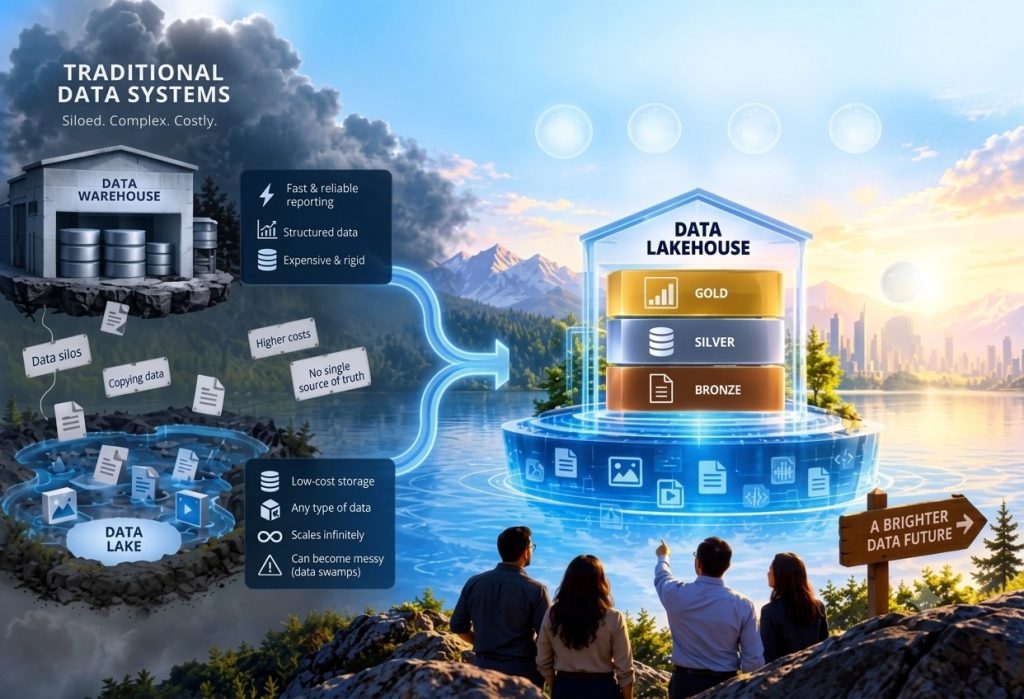
Databricks was created by the original team behind Apache Spark. It started as a managed Spark service and evolved into a unified analytics and AI platform built on the lakehouse architecture.
Databricks is for engineers who write code. Python, SQL, Scala, or R. It gives you deep programmatic access and granular control over your data pipelines.
Microsoft Fabric
Fabric is Microsoft’s all-in-one data platform, launched in 2023. It bundles Azure Synapse, Data Factory, Power BI, and more into a single SaaS product that runs exclusively on Azure.
Fabric is for organizations already invested in Microsoft. It offers seven workloads in one workspace: Data Engineering, Data Warehouse, Data Science, Real-Time Intelligence, Data Factory, Power BI, and Data Activator.
Storage and Architecture
All three platforms have different approaches to storage. Snowflake uses a proprietary columnar storage format. Your data lives in Snowflake’s managed storage, and you access it through its SQL engine.
Databricks uses Delta Lake, an open table format built on Parquet. Your data physically lives in your cloud provider’s storage, like AWS S3 or Azure Data Lake. Databricks recently introduced UniForm, which automatically writes Iceberg metadata alongside Delta, allowing Iceberg-native engines to read the same data.
Microsoft Fabric uses OneLake, a unified storage layer where every item is stored natively in Delta Parquet format. This eliminates duplicate storage and traditional copy-paste ETL.
One important difference: Snowflake and Databricks are truly multi-cloud. You can run them on AWS, Azure, or GCP. Fabric runs only on Azure.
Who Is Each Platform For?
This is where the real differences show up.
Choose Snowflake If…
Your team lives in SQL. You have business analysts running unpredictable queries and you need bulletproof reliability. You value simplicity above all else. You have multi-cloud requirements or large data sharing use cases. Snowflake is purpose-built for multi-cloud SQL analytics.
Choose Databricks If…
You have serious data science and machine learning workloads. Your team is code-first and comfortable with Python and Spark. You need granular engineering control and want to build custom pipelines. Databricks delivers the strongest unified analytics and ML platform.
Choose Microsoft Fabric If…
You are already deep in the Microsoft ecosystem with Microsoft 365 and Power BI. You want everything integrated in one place. You have a mix of technical and non-technical users who need to collaborate. Fabric gives you Power BI built right into the platform.
What About Pricing?
Pricing models are very different across the three platforms.
Microsoft Fabric uses capacity-based F-SKUs. F2 starts at around $263 per month. F64, which unlocks full Direct Lake mode and unlimited Power BI viewers, costs about $8,410 per month.
Snowflake uses credit-based consumption pricing. You pay approximately $2 to $4 per credit depending on the edition, plus separate storage costs.
Databricks uses DBU-based pricing. You pay approximately $0.40 to $0.95 per DBU depending on compute type, plus cloud infrastructure costs.
At a 100 TB workload with moderate concurrency, here is what you can expect annually:
- Fabric: roughly $60,000 to $100,000 all-in
- Snowflake: roughly $150,000 to $300,000 (compute + storage)
- Databricks: roughly $200,000 to $400,000 (compute + cloud infra)
Keep in mind that all three vendors discount heavily for committed spend. Your actual costs will depend on your usage patterns and negotiation.
The Question No One Asks
Here is the question that gets buried under feature comparisons and cost spreadsheets. Which platform fits the team you actually have, not the team you might hire in two years?
Every platform can run a modern data stack. The differences are not really about capability anymore. They are about which platform’s defaults align with your team’s skills, your existing tools, and your decision-making style.
A SQL-heavy team running Power BI all day will move five times faster on Fabric than on Databricks. A Python and Spark team doing real ML will fly on Databricks and struggle on Fabric. A team that values simplicity above all else will love Snowflake and find both Fabric and Databricks too busy.
Making the Right Choice
There is no single right answer. I have seen clients switch from Databricks to Fabric because they could not keep enough Spark engineers and their use case was 90 percent reporting. I have also seen teams try Fabric, find it too constraining for their data science work, and move core ML workloads to Databricks while keeping Power BI on Fabric. Both decisions were correct for their context.
How Singularity Hypertech Can Help
Choosing between Snowflake, Databricks, and Microsoft Fabric is a big decision. The wrong choice can cost you hundreds of thousands of dollars over three years.
This is where Singularity Hypertech comes in. They have guided enterprises through this exact decision. They understand the strengths and limitations of each platform and can help you assess which one fits your team, your data, and your business goals.
Singularity Hypertech does not just sell licenses. They provide hands-on expertise to design, build, and optimize your data platform. Whether you are a Microsoft shop considering Fabric, a multi-cloud enterprise looking at Snowflake, or a data science team leaning toward Databricks, they can help you make the right call.
Stop guessing. Start building with confidence. Reach out to Singularity Hypertech today and get the clarity you need to move forward.